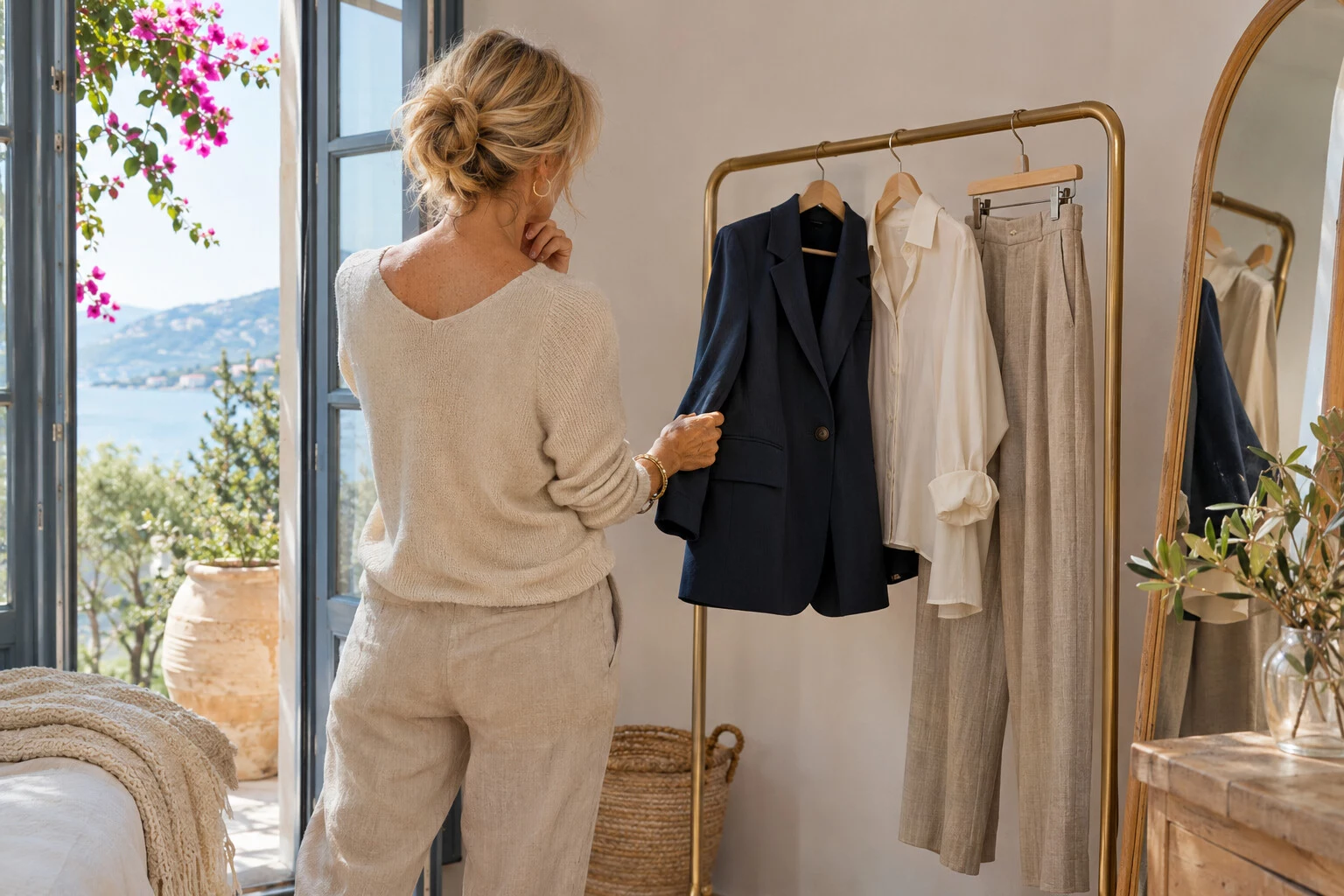
Some clothes have done nothing wrong, yet they make opening the wardrobe feel like starting an unfinished conversation. The jeans that once fastened without negotiation, the jacket that belonged to a different routine, the dress bought for a version of us who went out more and slept less.
After 50, getting dressed can become a daily comparison between today's body and the memory of the one we had ten or twenty years ago. The problem is not that bodies change. It is asking today's body to behave like an old photograph before it is allowed to wear something lovely.
A size is information, not a verdict
A label helps us find a garment in a shop. It knows nothing about our life, how far we walk, how loudly we laugh or what we have lived through. Sizing also varies wildly between brands: the same body can leave a fitting room carrying three different numbers.
Choose drape, comfort and proportion rather than numerical pride. If the next size lets a blazer fall cleanly across the shoulders, that is the right size. Buying the smaller one to wait for “someday” merely turns the wardrobe into a room full of criticism.
Begin with how you want to feel
Before thinking about trends, choose three words: comfortable, polished, relaxed; perhaps joyful, feminine and practical. There is no official mature-woman combination. These words are a better filter than “does this make me look younger?” or “am I too old for this?”
A shirt that lets you move, trousers whose waistband does not demand constant attention and shoes that can carry you all the way to the table are far more sophisticated than an outfit you must adjust every five minutes.
Fit often matters more than fashion
We do not always need a different body or an entirely new wardrobe. Sometimes we need a small alteration. Shortening a sleeve, lifting a hem, moving a button or gently shaping a jacket can turn an almost-right piece into one that looks made for us.
Notice where garments finish, too. A jumper can feel heavy if it ends at the widest point; a few centimetres higher or lower changes the proportion. This is not about hiding. It is about guiding the eye and letting clothes support the body instead of interrupting it.
Keep what represents you, not what punishes you
There is no need to throw away every garment we no longer wear. A piece can hold a story and deserve to stay. But keeping two memories is different from storing a whole collection of expectations with zips.
Sort honestly into four groups: what you wear and enjoy; what needs alteration; what no longer suits your life; and what is sentimental. The third group can leave without ceremony. The fourth needs a small box, not half the wardrobe rail.
Build for the life you actually live
A useful foundation does not have to be dull or beige. It needs to serve your real week. Whether you work from home, walk everywhere, care for other people or dine out once a week, clothes should make that life easier.
Two well-fitting pairs of trousers, a flexible blazer, several tops that brighten the face, one joyful colour and shoes that do not make you calculate distances may be enough. Earrings, a scarf or a bag can then change the mood without turning every morning into a production.
Getting dressed is not self-correction
There will be days when we like the mirror more and days when we like it less. Neutrality is allowed. We do not have to adore every centimetre in order to treat our bodies with respect. We can simply stop using clothes as punishment and start using them as tools.
Adult style is not about looking younger. It is about recognising ourselves without feeling that we are playing another woman. Today's body has not arrived late to our life. It is the body living it.
— Lucía