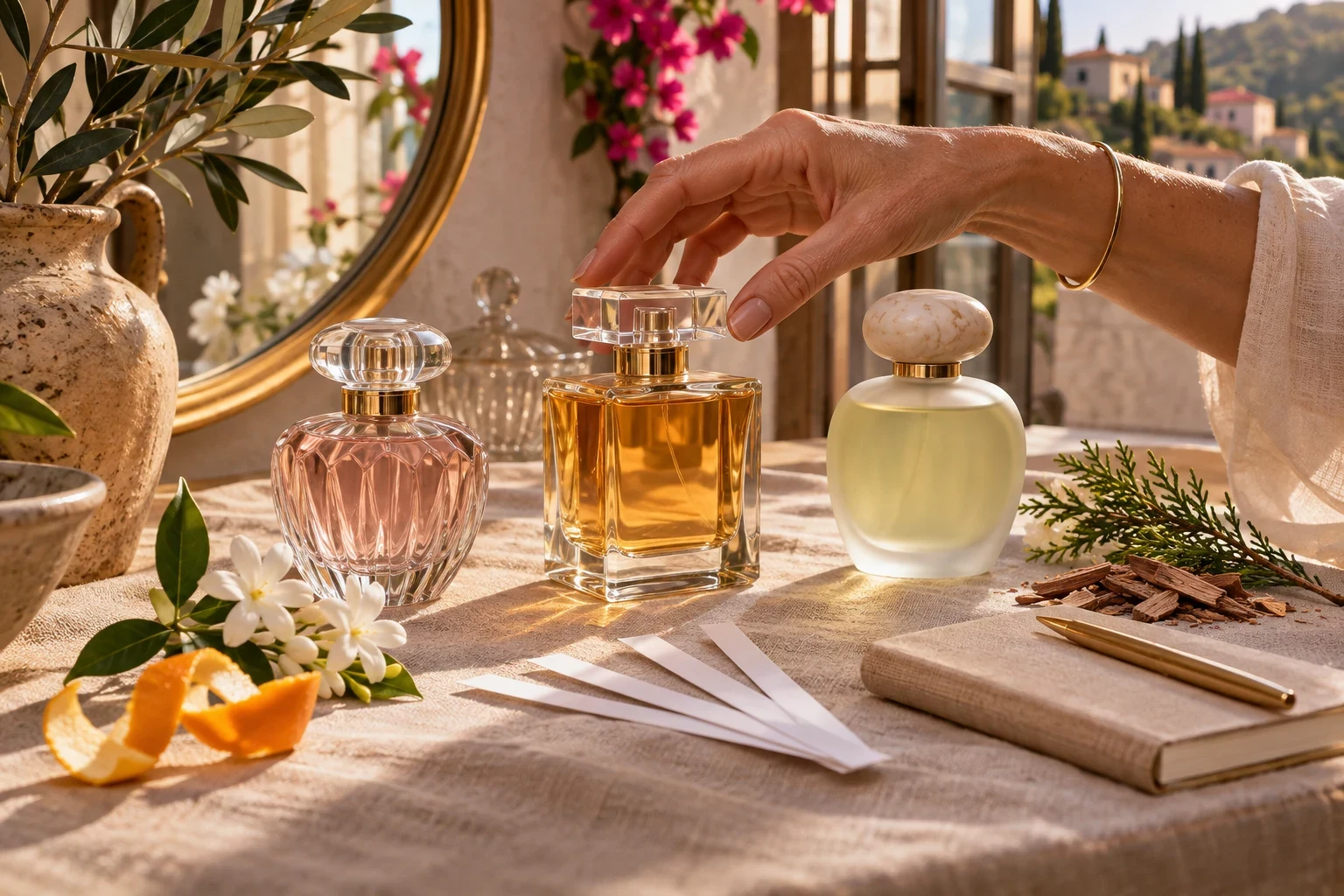
Some perfumes stay with us for years. We replace the bottle automatically because friends say, “That smells like you,” or because it has occupied the same corner of the bathroom through several hairstyles, jobs and versions of our life. Then one morning we spray it and something feels slightly wrong.
The fragrance has not suddenly become unpleasant. It may still be beautiful. It simply no longer tells the whole truth about the woman wearing it. Choosing a new perfume after 40 or 50 can be a wonderfully private pleasure: deciding how you want to feel without consulting your age, your habits or anyone else’s idea of sophistication.
Perfume has no age bracket
Beauty advice has long tried to divide fragrance by age. Young women are given bright, airy scents; older women are directed towards something richer, darker and supposedly more serious. It makes about as much sense as assigning lipstick colours by decade.
A citrus fragrance does not expire when you turn fifty, and a deep woody scent does not require a certain birth year. The useful question is not, “Is this suitable for my age?” but, “Do I enjoy the person I feel like when I wear it?” You might want green freshness, soft flowers, warm woods or something quiet that stays close to the skin. Maturity should expand your freedom to choose, not narrow the shelf.
Start with a mood, not a vocabulary test
A fragrance counter can feel like a lesson you forgot to prepare for. There are top notes, heart notes, dry-downs, amber, musk and a dozen ingredients you may never have smelled on their own. None of that needs to be your starting point.
Begin with an atmosphere. Do you want to feel crisp, calm, bright, sensual, comforting or quietly confident? Is this for ordinary mornings, evenings out, or days when you want a small shift in energy? A mood gives the person helping you something far more useful than pretending to understand every technical description.
Think about perfumes you have enjoyed and what they shared, but do not turn the pattern into a rule. Perhaps you have always worn white florals and now want something drier. Perhaps bold scents once suited you and today you prefer a fragrance that does not enter the room before you do.
Smell fewer things and give them more time
Testing six fragrances in quick succession usually produces one result: everything begins to smell like a very determined department store. Choose two or three instead. Try them on blotters first, then put the favourite on your skin.
You do not have to decide at the counter. Walk around, have coffee, continue with your day and return to your wrist later. Fragrance changes between the opening spray and what remains after an hour or two. The second part matters just as much as the first.
If you are uncertain, ask for a sample when one is available, or come back another day. Taking your time does not make the experience less romantic. It prevents a beautiful bottle from becoming expensive furniture while you quietly return to the old favourite.
Let your skin make the final decision
A perfume can feel different on paper, on another person and on your own skin. Test it where you will actually wear it, ideally without a strongly scented lotion or another fragrance competing underneath.
Notice comfort as well as beauty. You can admire a perfume and still find it tiring after several hours. That is not a failure of taste. Not everything impressive needs to live on your wrist.
Quantity changes the experience too. Some perfumes tolerate a generous spray; others are at their best with a light touch. Part of choosing a scent is deciding how much presence you want it to have: company, not an announcement from the lift.
You do not need one signature forever
The idea of a signature scent is lovely: a fragrance people associate with you, a small memory that remains after you leave. But it need not be a lifelong contract. You can own two or three, change with the season or the occasion, and return to an old favourite after months away.
A small, purposeful wardrobe often works better than one enormous bottle. You might like something fresh for daytime, something warmer for evening and one scent you wear not for “special occasions” but whenever you want to feel especially yourself. The point is not to collect. It is to give each bottle a reason to be there.
Memory matters, but it does not get the final vote
Scent stores memories with astonishing efficiency. One spray can bring back a relationship, a house, a holiday or a younger version of you. Sometimes that is comforting. Sometimes it makes the fragrance heavier than the bottle suggests.
Stopping a perfume connected to an old chapter does not erase the chapter or make your former choice foolish. It simply acknowledges that you have changed. The reverse can happen too: you may revisit an old scent and discover that it now belongs to you in a new way, without the past taking up all the room.
You do not owe anyone an explanation for moving on. An adult identity is not a museum display. It is more like a lived-in home: it keeps treasured objects, moves the furniture and opens a window when the air needs changing.
Choosing for pleasure is a form of care
Trying perfume can be a ritual without an obligation to buy. Go when you are not rushing, avoid wearing another fragrance, and write down the name of anything that intrigues you. If you are still thinking about it the next day, that is useful information. If you forget it completely, that is useful too.
The best perfume is not the most expensive, the loudest or the one that promises impossible youth. It is the scent that makes you lift your wrist again because you enjoy finding it there. It can be subtle or bold, floral or woody, brand-new or rediscovered. The only person it needs to suit is you.
A new fragrance will not transform your life, but it can accompany a transformation already under way. Not every new chapter begins with a dramatic announcement. Sometimes it begins with a small spray, an open door and the quiet recognition that this finally smells like you again.
— Lucía