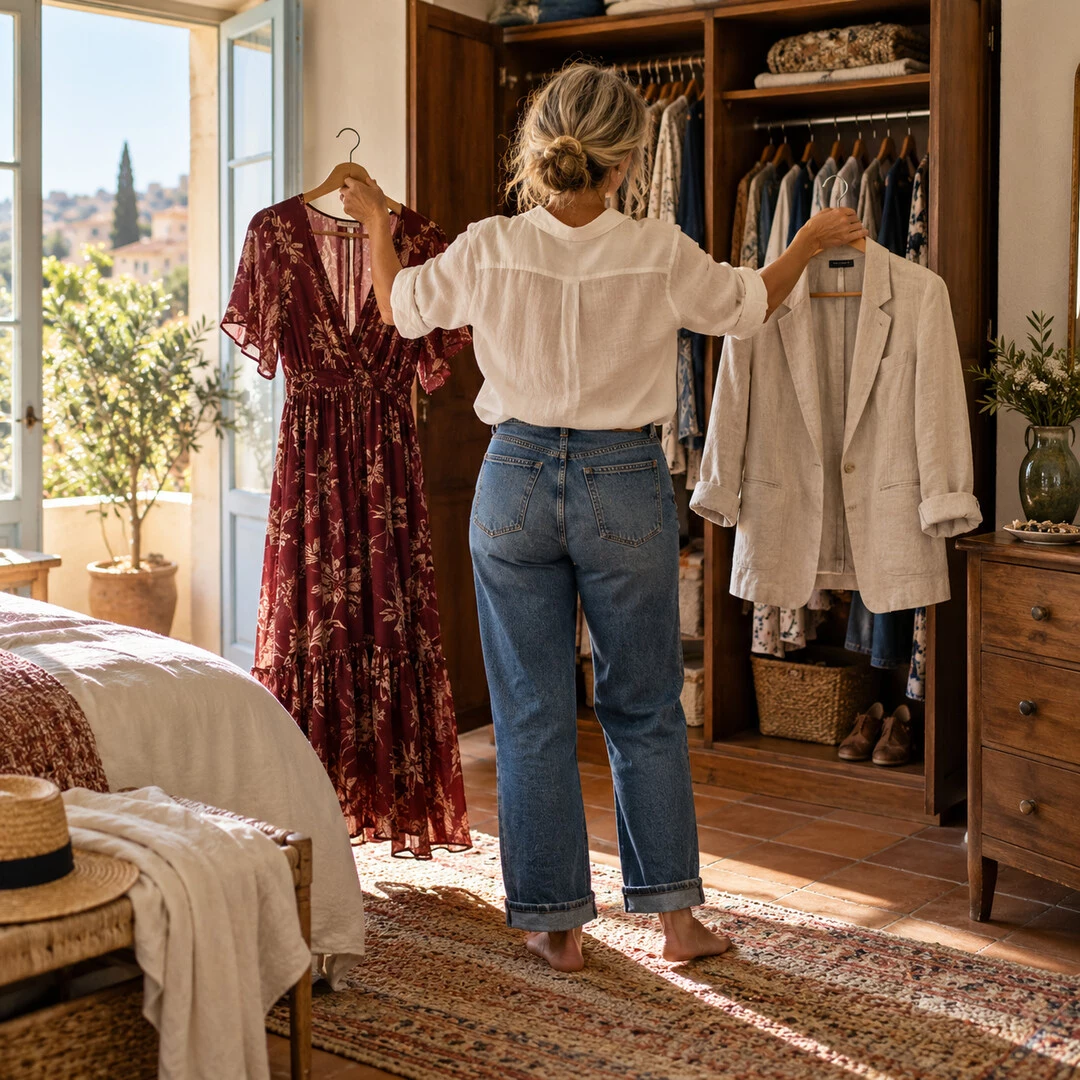
There is a fascinating woman living in many of our wardrobes. She attends dinners that begin at half past nine, wears white linen without spilling anything and has an astonishing tolerance for painful shoes. She owns dresses for openings, jackets for important meetings and a delicate blouse that, for reasons nobody understands, never needs ironing.
The only problem is that she is not always us. Sometimes we buy a garment when what we are really buying is the life we imagine wearing it in.
It was not a bad purchase; it was the wrong casting
The item may be beautiful, flattering and reasonably priced. Yet the label stays on because it was chosen for a character who rarely appears in our week. Fantasy is not the problem. The problem begins when the wardrobe is full of costumes and we are still saying we have nothing to wear.
After 40, we know more about our actual plans, schedules and preferences. We know whether we walk a lot, feel cold in restaurants, hate adjusting an outfit every five minutes or need pockets with an intensity that is almost political. That information is far more useful than any trend report.
The ordinary Tuesday test
Before buying something, picture it on an unremarkable Tuesday rather than an ideal holiday. Which shoes would go with it? Can you sit comfortably? Does it work with at least three pieces you already own? Could you wear it to work, meet a friend or run an errand without feeling as though you are in costume?
This does not mean buying only jeans and grey T-shirts. Even a special piece simply needs a bridge into everyday life. A printed dress might work with sandals, trainers or a plain jacket. A good blazer can accompany tailored trousers, but also the jeans we genuinely wear.
Buying for today's body is not giving up
Many of us also keep clothes for the body we once had, or for a future body burdened with far too many conditions. Dressing well starts when we stop treating our present body like a waiting room.
A size is manufacturing information, not a moral assessment. If a garment pinches, rides up, digs in or requires us to hold our breath, it is not motivating us; it is annoying us. Choosing a size that lets us move, eat and forget about our clothes for a few hours is a remarkably sophisticated style decision.
Comfort does not have to look like surrender
Comfort is not the absence of shape, colour or intention. It can mean a fabric that feels good, a waistband that moves with us, a neckline that needs no supervision or shoes that leave our sense of humour intact at the end of the day.
The useful trick is to identify exactly what feels wrong. Perhaps we do not dislike dresses; we dislike dresses that cannot be worn with a bra. Maybe we have not abandoned heels, only the ones that turn twenty metres into a pilgrimage. Once the problem is specific, we can stop rejecting whole categories and choose more intelligently.
Keep a little room for fantasy
A realistic wardrobe should not look like an emergency supply cupboard. Some clothes bring joy even if they come out less often: a red dress, a sparkling jacket, enormous earrings. They deserve a place if we wear them, recognise ourselves in them and they are not eternally waiting for a different life.
There is a difference between keeping one special piece and maintaining an entire collection for events that never arrive. Give fantasy a small corner. Let the rest of the wardrobe work alongside you.
A good purchase reveals itself later
The best purchase is not always the one that creates the biggest thrill in the changing room. Often it is the piece we reach for again six months later before it has fully dried. It combines easily, avoids an emergency summit in front of the mirror and still feels like us on an ordinary day.
Before paying, ask: “Am I buying clothes, or an imaginary version of my life?” If it is the latter, there is no need for self-criticism. Return the dress to its rail and thank it for ten entertaining minutes of fiction. Sometimes leaving a shop without a bag is a style choice too.