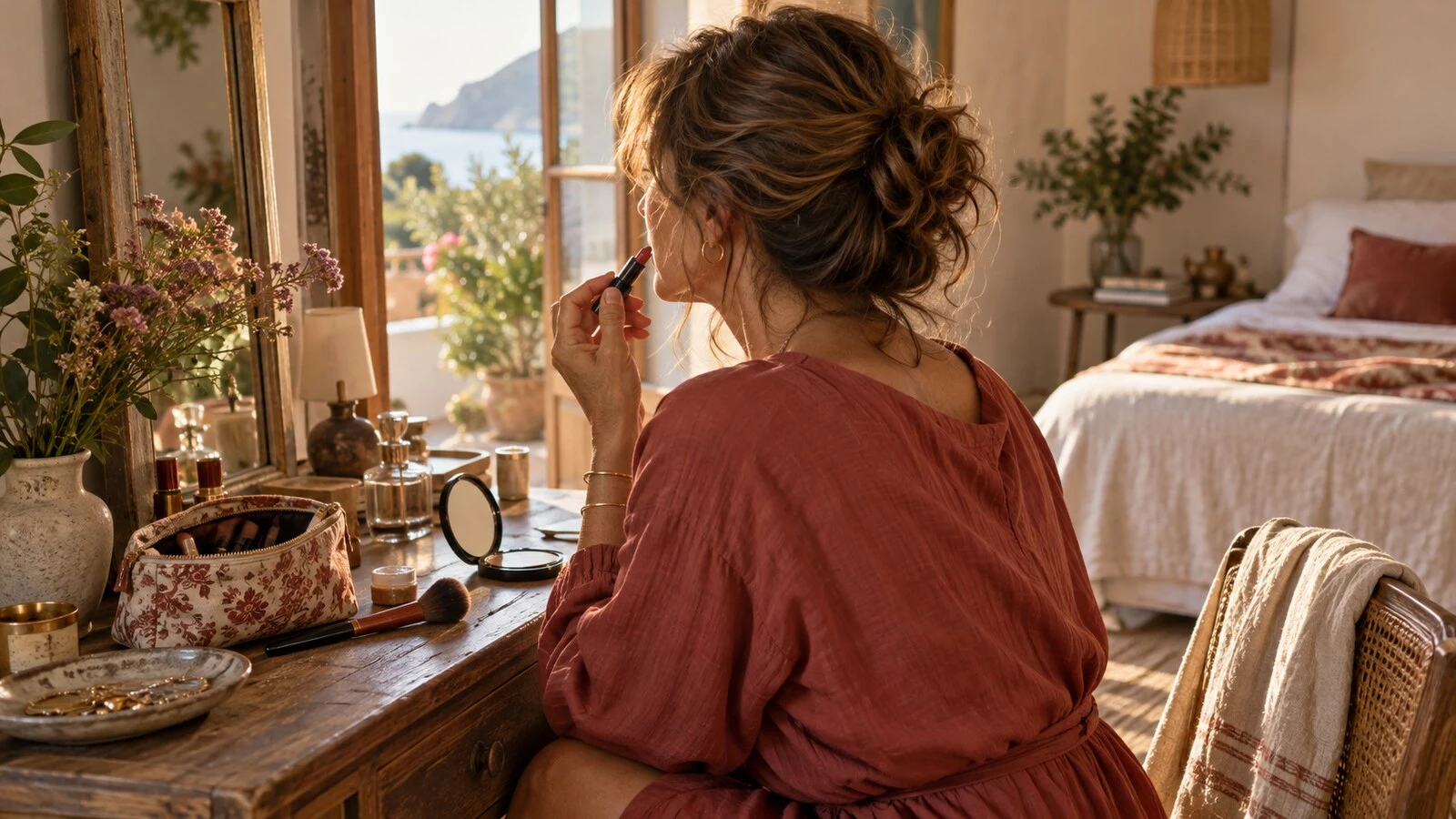
For years, I approached make-up as if it were an administrative task: hide the tiredness, cover a mark, look more awake than I felt. My make-up bag was less a box of colour and more a tiny emergency repair kit. Then one day I realised I did not want to begin every morning by searching for something to correct.
Wearing make-up after 40 — or not wearing it — can be much simpler than that: a choice. Some days I fancy red lipstick even if I am only going out for coffee. On others, I leave with a bare face and sunglasses. Neither version owes anyone an explanation.
The mirror is not an inspection
Some mornings we lean far too close to the mirror, counting lines, examining pores and looking for evidence of a short night as though someone were about to grade us. Yet nobody looks at us from twenty centimetres away under harsh bathroom lighting. More importantly, we should not always look at ourselves that way either.
Before reaching for a brush, step back and ask a kinder question: what would I enjoy highlighting today? It might be your lips, your lashes or simply skin that carries years of laughter, sunshine and worries survived. Replacing “what must I hide?” with “what would I like to enjoy?” changes the entire ritual.
Fewer products, more intention
You do not need to replace everything you own or master a twelve-step technique. A grown-up routine can take only a few minutes and a handful of products:
- A comfortable moisturiser that leaves your skin supple.
- Concealer only where you genuinely want it, not because it is compulsory.
- A touch of blush or bronzer for warmth, without trying to draw a different face.
- Mascara if it makes you feel brighter.
- A lipstick you love, even if it is neither “subtle” nor supposedly suitable for your age.
Texture often matters more than coverage. Light, creamy formulas that blend easily tend to sit more comfortably on skin that moves. The aim is not to freeze it but to let it continue looking like skin.
Lighting changes more than age does
We often blame the years for what a cruel light bulb is doing. Applying make-up beside a window makes colour and quantity easier to judge. It also prevents that outdoor discovery that your foundation has started an independent life along your jawline.
When you finish, look at the whole effect from a little distance. Make-up belongs to a face, and that face belongs to a complete woman. We are not permanent close-ups.
Leave room to play
When we were younger, we tried colours without asking permission. Then came work, children, deadlines and that peculiar list of shades someone decided were “appropriate” at each age. Bringing back blue eyeliner, a shimmering shadow or a strong red can be a small act of freedom.
This is not about wearing everything at once or turning each morning into a production. It is about remembering that make-up can be play. If a colour lifts your mood, it has already done something more interesting than disguising a line.
Bare-faced days count too
Choosing make-up is only freedom when not wearing it is also an option. Some days I would rather spend those five minutes finishing my coffee while it is still hot. It does not mean I have given up or that I am unhappy. It simply means I did not feel like it today.
Perhaps the healthiest relationship with make-up is to use it when it adds something and leave it when it feels like a burden. A bare face is not automatically bravery, and a made-up face is not insecurity. Sometimes it is care, sometimes it is fun, and sometimes it means nothing at all.
A little ritual of your own
Now, when I sit in front of the mirror, I try to make it a pause rather than an examination. I open my make-up bag, choose something because I like it and put on music if there is time. I am not trying to be thirty again. At thirty, I did not know many of the things that make me feel at ease today.
I want to recognise myself, not travel backwards. And if today that recognition comes with a little blush and the lipstick I had been saving for a special occasion, so much the better. Apparently, the occasion was me.